

How To Draw The Brachial Plexus In 5 Minutes
The Brachial plexus is a plexus of nerves which is made up of the C4, C5, C6, C7, C8 and T1 spinal fretfulness. The C4 to C8 spinal fretfulness are the inductive (ventral) rami of the lower 4 cervicals and T1 is the first thoracic nervus.
The Brachial plexus supplies afferent and efferent nervus fibers to the chest, shoulder, arm and hand.
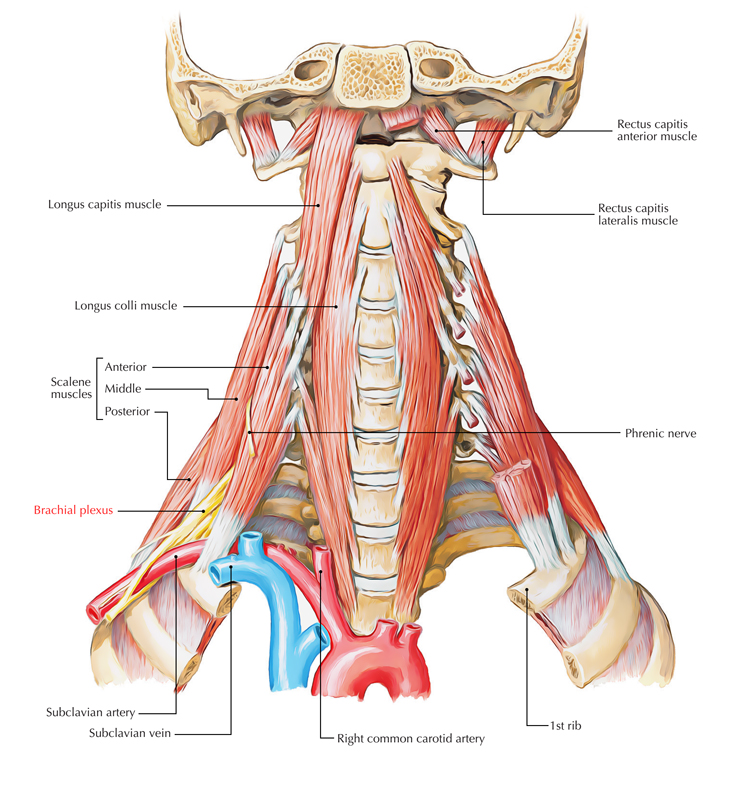
Brachial Plexus
Components of The Brachial Plexus
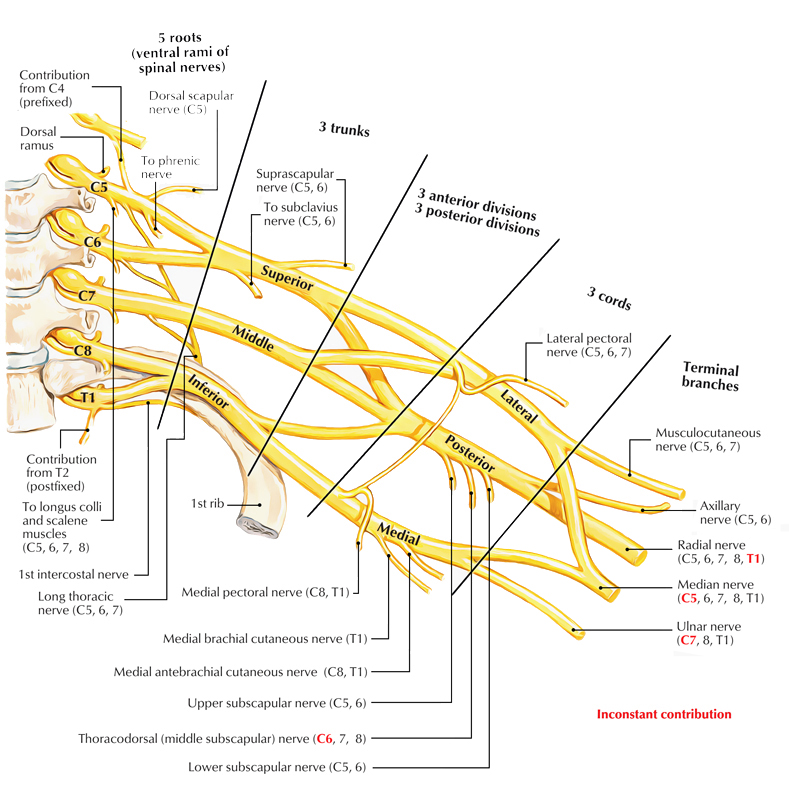
The brachial plexus consists of four components: (a) roots, (b) trunks, (c) divisions, and (d) cords. The roots and trunks arc located in the cervix, divisions behind the clavicle and the cords in the axilla.
Roots of The Brachial Plexus
The roots of the brachial plexus are the anterior rami of C5 to C8, and most of T1. Close to their origin, the roots receive grayness rami communicates from the sympathetic torso. These behave postganglionic sympathetic fibres onto the roots for distribution to the periphery.
The roots and trunks enter the posterior triangle of the neck past passing between the anterior scalene and center scalene muscles and lie superior and posterior to the subclavian artery.
Brachial Plexus
Trunks of The Brachial Plexus
The 3 trunks of the brachial plexus originate from the roots, laissez passer laterally over rib I, and enter the axilla:
- The superior body is formed by the union of C5 and C6 roots.
- The middle trunk is a continuation of the C7 root.
- The inferior body is formed past the union of the C8 and T1 roots.
The inferior body lies on rib I posterior to the subclavian avenue; the middle and superior trunks are more superior in position.
Divisions of The Brachial Plexus
Each of the three trunks of the brachial plexus divides into an anterior and a posterior partition:
- The three anterior divisions form parts of the brachial plexus that ultimately give rising to peripheral nerves associated with the inductive compartments of the arm and forearm.
- The 3 posterior divisions combine to form parts of the brachial plexus that requite rising to fretfulness associated with the posterior compartments.
- No peripheral nerves originate directly from the divisions of the brachial plexus.
Cords of The Brachial Plexus
The three cords of the brachial plexus originate from the divisions and are related to the second part of the axillary artery:
- The lateral string results from the union of the anterior divisions of the upper and middle trunks and therefore has contributions from C5 to C7—it is positioned laterally to the second part of the axillary artery.
- The medial cord is medial to the second part of the axillary artery and is the continuation of the anterior division of the inferior trunk—it contains contributions from C8 and Tl.
- The posterior cord occurs posterior to the 2d part of the axillary artery and originates as the union of all three posterior divisions—it contains contributions from all roots of the brachial plexus (C5 to T1).
Most of the major peripheral nerves of the upper limb originate from the cords of the brachial plexus. More often than not, nerves associated with the anterior compartments of the upper limb arise from the medial and lateral cords and nerves associated with the posterior compartments originate from the posterior string.
Branches of The Brachial Plexus
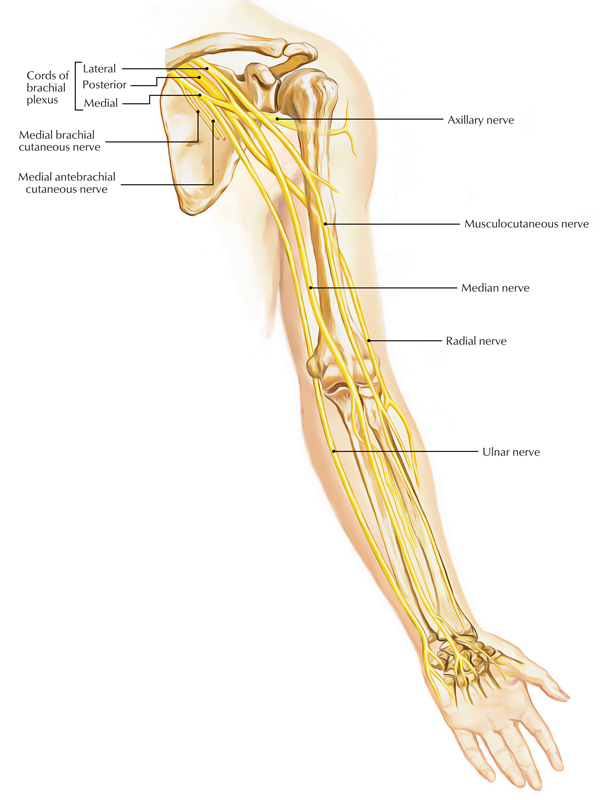
Brachial Plexus: Branches
Branches of the Roots
In improver to small segmental branches from C5 to C8 to muscles of the cervix and a contribution of C5 to the phrenic nerve, the roots of the brachial plexus give rise to the dorsal scapular and long thoracic nerves.
The Dorsal Scapular Nerve
- Originates from the C5 root of the brachial plexus.
- Passes posteriorly, frequently piercing the middle scalene muscle in the neck.
- To achieve and travel along the medial border of the scapula and innervates the rhomboid major and minor muscles from their deep surfaces.
The Long Thoracic Nerve
- Originates from the inductive rami of C5 to C7.
- Passes vertically down the cervix, through the axillary inlet, and downwardly the medial wall of the axilla to supply the serratus anterior muscle, and lies on the superficial aspect of the serratus anterior muscle.
Branches of the Trunks
The just branches from the trunks of the brachial plexus are ii nerves that originate from the superior trunk (upper trunk): the suprascapular nervus and the nervus to the subclavius muscle.
The suprascapular nerve (C5 and C6):
- originates from the superior trunk of the brachial plexus,
- passes laterally through the posterior triangle of the neck and through the suprascapular foramen to enter the posterior scapular region,
- innervates the supraspinatus and infraspinatus muscles, and
- is accompanied in the lateral parts of the neck and in the posterior scapular region by the suprascapular artery.
The nerve to the subclavius musculus (C5 and C6) is a minor nervus that:
- Originates from the superior trunk of the brachial plexus.
- Passes anteroinferiorly over the subclavian artery and vein.
- Innervates the subclavius muscle.
Branches of the Lateral Cord
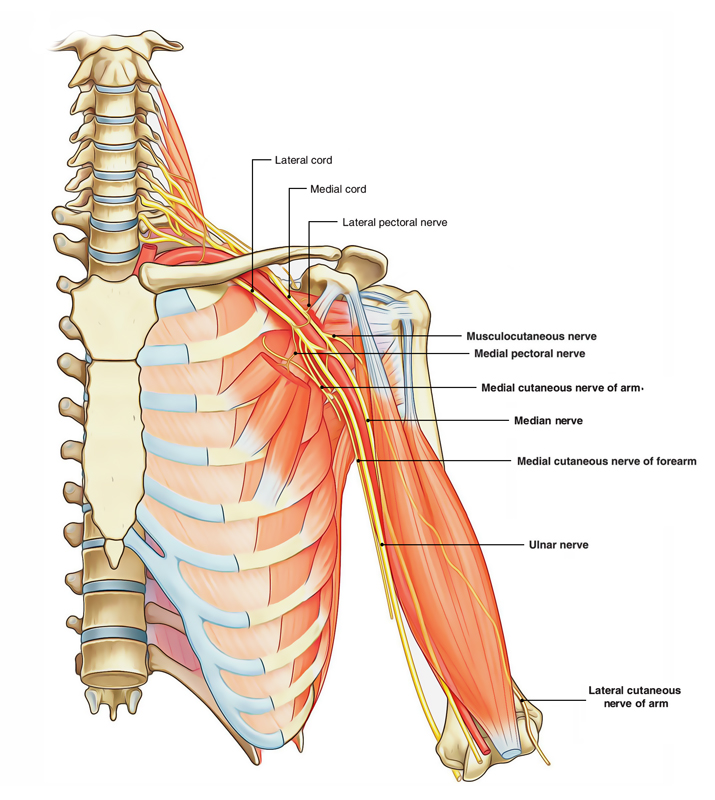
Brachial Plexus: Branches of Lateral Cord
3 nerves originate entirely or partly from the lateral cord of the brachial plexus.
- The lateral pectoral nerve is the nigh proximal of the branches from the lateral string. It passes anteriorly, together with the thoracoacromial avenue, to penetrate the clavipectoral fascia that spans the gap betwixt the subclavius and pectoralis minor muscles, and innervates the pectoralis major musculus.
- The musculocutaneous nervus is a big terminal branch of the lateral cord. It passes laterally to penetrate the coracobrachialis musculus and pass betwixt the biceps brachii and brachialis muscles in the arm, and innervates all three flexor muscles in the inductive compartment of the arm, terminating as the lateral cutaneous nerve of the forearm. The lateral root of the median nerve is the largest concluding co-operative of the lateral cord and passes medially to join a like branch from the medial string to form the median nerve.
Branches of the Medial Cord
Brachial Plexus: Branches of Medial String
The medial string of the brachial plexus has five branches.
- The medial pectoral nerve is the most proximal branch. It receives a communicating branch from the lateral pectoral nervus and and so passes anteriorly between the axillary artery and axillary vein. Branches of the nerve penetrate and supply the pectoralis modest muscle. Some of these branches pass through the musculus to attain and supply the pectoralis major muscle. Other branches occasionally pass effectually the inferior or lateral margin of the pectoralis pocket-sized muscle to reach the pectoralis major muscle.
- The medial cutaneous nerve of the arm (medial brachial cutaneous nerve) passes through the axilla and into the arm where information technology penetrates deep fascia and supplies pare over the medial side of the distal third of the arm. In the axilla, the nervus communicates with the intercostobrachial nerve of T2. Fibers of the medial cutaneous nerve of the arm innervate the upper part of the medial surface of the arm and floor of the axilla.
- The medial cutaneous nerve of the forearm (medial antebrachial cutaneous nerve) originates just distal to the origin of the medial cutaneous nerve of the arm. It passes out of the axilla and into the arm where it gives off a branch to the skin over the biceps brachii muscle, and then continues down the arm to penetrate the deep fascia with the basilic vein, continuing interiorly to supply the skin over the anterior surface of the forearm. It innervates pare over the medial surface of the forearm down to the wrist.
- The medial root of the median nervus passes laterally to join with a like root from the lateral cord to form the median nerve anterior to the third part of the axillary avenue.
- The ulnar nerve is a large terminal branch of the medial cord. Withal, well-nigh its origin, it frequently receives a communicating branch from the lateral root of the median nerve originating from the lateral cord and carrying fibers from C7. The ulnar nerve passes through the arm and forearm into the hand where it innervates all intrinsic muscles of the paw (except for the 3 thenar muscles and the 2 lateral lumbrical muscles). On passing through the forearm, branches of the ulnar nervus innervate the flexor carpi ulnaris musculus and the medial half of the flexor digitorum profundus musculus. The ulnar nerve innervates skin over the palmar surface of the little finger, medial one-half of the ring finger, and associated palm and wrist, and the skin over the dorsal surface of the medial part of the hand.
Median nervus
The median nerve is formed anterior to the tertiary function of the axillary artery by the union of lateral and medial roots originating from the lateral and medial cords of the brachial plexus.
Information technology passes into the arm, inductive to the brachial artery and through the arm, into the forearm, where its branches innervate most of the muscles in the anterior compartment of the forearm. However, it does not innervate the flexor carpi ulnaris muscle and the medial half of the flexor digitorum profundus musculus, which are innervated by the ulnar nerve.
The median nerve continues into the manus to innervate:
- the iii thenar muscles associated with the thumb,
- the ii lateral lumbrical muscles associated with motion of the index and center fingers, and
- the skin over the palmar surface of the lateral three and half digits and over the lateral side of the palm and middle of the wrist.
The musculocutaneous nerve, the lateral root of the median nerve, the median nerve, the medial root of the median nerve, and the ulnar nerve form an K over the tertiary part of the axillary artery. This feature, together with penetration of the coracobrachialis muscle by the musculocutaneous nerve, tin exist used to identify components of the brachial plexus in the axilla.
Branches of the Posterior String
5 fretfulness originate from the posterior cord of the brachial plexus:
- The superior subscapular nerve
- The thoracodorsal nerve
- The inferior subscapular nerve
- The axillary nerve
- The radial nerve.
All these nerves except the radial nerve innervate muscles associated with the posterior wall of the axilla; the radial nerve passes into the arm and forearm.
- The superior subscapular, thoracodorsal, and junior subscapular nerves originate sequentially from the posterior cord and pass directly into muscles associated with the posterior axillary wall. The superior subscapular nervus is short and passes into and supplies the subscapularis muscle.
- The thoracodorsal nerve is the longest of these three nerves and passes vertically along the posterior axillary wall. Information technology penetrates and innervates the latissimus dorsi muscle.
- The inferior subscapular nervus besides passes inferiorly along the posterior axillary wall and innervates the subscapularis and teres major muscles.
- The axillary nerve originates from the posterior cord and passes inferiorly and laterally forth the posterior wall to go out the axilla through the quadrangular infinite. Information technology passes posteriorly around the surgical cervix of the humerus and innervates both the deltoid and teres minor muscles.
- A superior lateral cutaneous nervus of the arm originates from the axillary nerve after passing through the quadrangular space and loops around the posterior margin of the deltoid muscle to innervate skin in that region. The axillary nerve is accompanied past the posterior circumflex humeral artery.
- The radial nerve is the largest terminal branch of the posterior cord. It passes out of the axilla and into the posterior compartment of the arm by passing through the triangular interval between the inferior border of the teres major muscle, the long caput of the triceps brachii muscle, and the shaft of the humerus. It is accompanied through the triangular interval past the profunda brachii avenue, which originates from the brachial avenue in the anterior compartment of the arm. The radial nerve and its branches innervate all muscles in the posterior compartments of the arm and forearm, and the skin on the posterior aspect of the arm and forearm, the lower lateral surface of the arm, and the dorsal lateral surface of the hand.
- The posterior cutaneous nerve of the arm (posterior brachial cutaneous nerve) originates from the radial nerve in the axilla and innervates pare on the posterior surface of the arm.
Spinal Segment, Nerves and Distribution Table
| Spinal Segments | Nerve(southward) | Distribution |
| c4-c6 | Nerve to subclavius | Subclavius muscle |
| C5 | Dorsal scapular nervus | Rhomboid and levator scapulae muscles |
| Cv-C7 | Long thoracic nervus | Serratus anterior muscle |
| C5,C6 | Suprascapular nerve | Supraspinatus and infraspinatus muscles; sensory from shoulder joint and scapula |
| C5-Tone | Pectoral nerves (medial and lateral) | Pectoralis muscles |
| c5,c6 | Subscapular nerves | Subscapularis and teres major muscles |
| Q-C8 | Thoracodorsal nerve | Latissimus dorsi muscle |
| c5 – c6 | Axillary nerve | Deltoid and teres modest muscles; sensory from the skin of the shoulder |
| C8,Ti | Medial antebrachial cutaneous nerve | Sensory from pare over anterior, medial surface of arm and forearm |
| Cv-Tone | Radial nerve | Many extensor muscles on the arm and forearm (triceps brachii, anconeus, extensor carpi radialis, extensor carpi ulnaris, and brachioradialis muscles); supinator musculus, digital extensor muscles, and abductor pollicis muscle via the deep branch; sensory from skin over the posterolateral surface of the limb through the posterior brachial cutaneous nervus (arm), posterior antebrachial cutaneous nerve (forearm), and the superficial branch (radial portion of hand) |
| Cv-C7 | Musculocutaneous nerve | Flexor muscles on the arm (biceps brachii, brachialis, and coracobrachialis muscles); sensory from pare over lateral surface of the forearm through the lateral antebrachial cutaneous nerve |
| Chalf dozen-T1 | Median nervus | Flexor muscles on the forearm (flexor carpi radialis and palmaris longus muscles); pronator quadratus and pronator teres muscles; radial one-half of flexor digitorum profundus muscle, digital flexors (through the anterior interosseous nervus); sensory from skin over the anterolateral surface of the manus |
| Cviii-T1 | Ulnar nerve | Flexor carpi ulnaris muscle, ulnar half of flexor digitorum profundus musculus, adductor pollicis musculus, and small digital muscles through the deep co-operative; sensory from skin over medial surface of the hand through the superficial branch |
Clinical Correlation of The Brachial Plexus
Lesions of the Brachial Plexus
For understanding the effects of the lesions of the brachial plexus, the pupil will find it helpful to know the spinal segments, which control the various movements of the upper limb:
- Adduction of the shoulder is controlled past C5 segment.
- Abduction of the shoulder is controlled by C6 and C7 segments.
- Flexion of the elbow is controlled by C5 and C6 segments.
- Extension of the elbow is controlled past C6 and C7 segments.
- Flexion of the wrist and fingers is controlled past C8 and T1 segments.
The important lesions of the brachial plexus are as follows:
Erb'south Paralysis (upper plexus injury)
Information technology is caused by the excessive increment in the angle between the caput and shoulder, which may occur by autumn from the back of horse and landing on shoulder or traction of the arm during the birth of a kid. This involves upper torso (C5 and C6 roots) and leads to a typical deformity of the limb called policeman's tip hand/porter'southward tip manus/waiter'southward tip hand. In this deformity, the arm hangs by the side, adducted and medially rotated, and the forearm is extended and pronated. The detailed account of clinical features of Erb's paralysis is as follows:
- Adduction of the arm due to paralysis deltoid muscle.
- Medial rotation of arm due to paralysis supraspinatus, infraspinatus, and teres modest muscles.
- Extension of the elbow, due to paralysis of biceps brachii.
- Pronation of forearm due to paralysis of biceps brachii.
- Loss of sensation (minimal) along the outer aspect of the arm due to the involvement of roots of C6 spinal nervus.
Klumpke's Paralysis (lower plexus injury)
Information technology is acquired by the hyperabduction of the arm, which may occur when ane falls on an outstretched hand or an arm is pulled into machinery or during delivery (extended arm in a breech presentation. The nerve roots involved in this injury are C8 and T1 and sometimes C7. The clinical features of Klumpke's paralysis are as follows:
- Claw manus, due to paralysis of the flexors of the wrist and fingers (C6, C7, and C8), and all intrinsic muscles of the hand (C8 and T1).
- Loss of sensations along the medial border of the forearm and mitt (T1).
- Horner's syndrome, (characterized by partial ptosis, miosis, anhydrosis, and enophthalmos) due to the involvement of sympathetic fibres supplying head and neck, which get out the spinal cord through T1.
Surgical Approach to Axilla
The axilla is approached surgically through the pare of the floor of axilla for the excision of axillary lymph nodes to care for the cancer of the breast. The structures at hazard during this process are intercostobrachial nerve, long thoracic nerve, thoracodorsal nerve, and thoracodorsal avenue. Effort should be fabricated to safeguard the above structures.
 Loading...

Source: https://www.earthslab.com/anatomy/brachial-plexus-anatomy-components-branches-trunks-and-cords/
Posted by: piercewhighletwor81.blogspot.com
0 Response to "How To Draw The Brachial Plexus In 5 Minutes"
Post a Comment